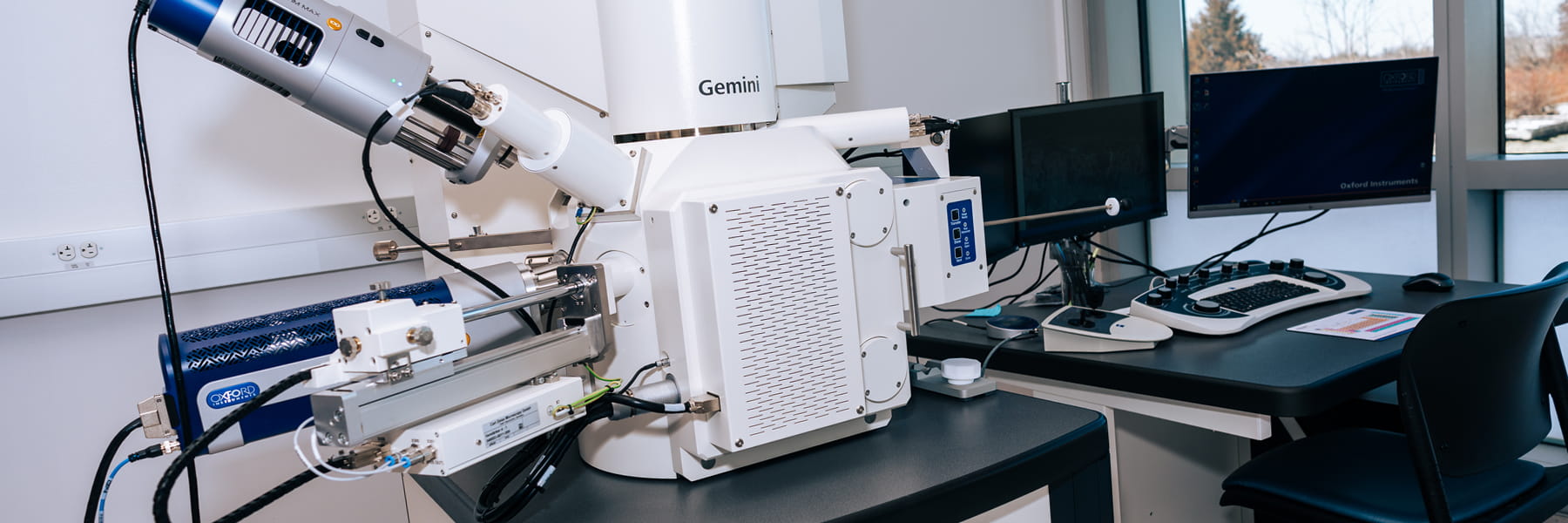
The Field Emission Scanning Electron Microscope (FESEM) Imaging & Electrochemical Materials Characterization Core Facility (FEMCC) is located at UMass Boston.
The FEMCC Core Facility offers a wide range of services, including sample characterization, preparation, and data extraction and analysis. The facility collaborates extensively with industry partners, including energy companies, materials development firms, and bioscience sectors. Please contact us to discuss project details and pricing.
FEMCC's services are provided by Dr. Niya Sa, director of the FEMCC, and her highly skilled research staff. Dr. Sa’s areas of expertise include electrochemistry, analytical chemistry, and green chemistry.
Equipment
The ZEISS Sigma500VP FESEM is an advanced field emission SEM that produces exceptional images at high and low accelerating voltages. With its analytical capabilities, this instrument is suitable for a wide range of applications. The instrument owns a high-resolution f ield emission column with a high-stability Schottky field gun, the beam current ranges from 1 pA to 400 nA, and the acceleration voltage range is from 200 eV to 30 keV.
Detectors: In-lens secondary electron, Everhart-Thornley secondary electron, variable pressure secondary electron, backscattered electron.
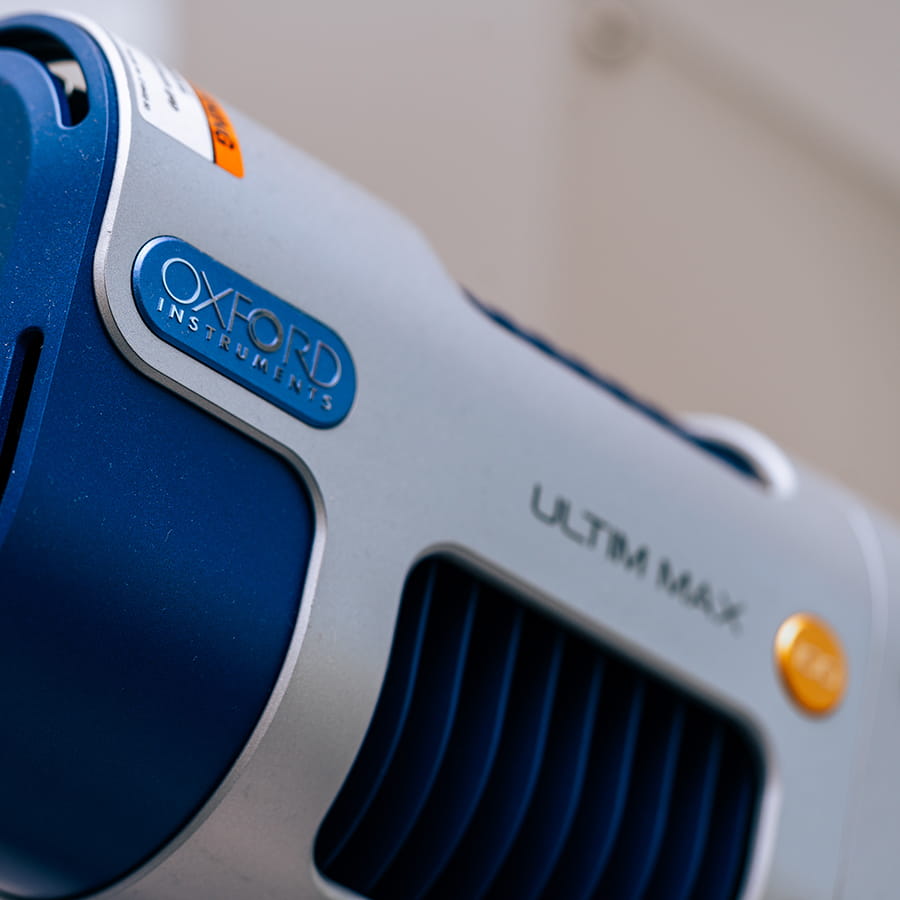
The instrument is equipped with an Oxford energy dispersive spectroscopy (EDS) system for elemental and chemical analysis of a sample inside the SEM.
Capabilities
- Examine high-resolution imaging with a magnification range from 10 to 400,000 times for various specimens, such as semiconductors, insulating materials, biological samples, cellulose fibers, biological cells, inorganic materials, polymers, nanocrystalline, etc.
- The energy dispersive X-ray spectrometer (EDX) is coupled with the high-resolution imaging function that resolves the chemical elemental mapping of the samples.
- The inert chamber is capable of handling air-sensitive samples without having samples exposed in air.
- Electron backscatter diffraction (EBSD) is capable of determining the local crystal structure and the crystal orientation at the surface of the samples.
- The solid-state Scanning Transmission Electron Microscopy (STEM) detectors allow transmitted electrons to be directly detected and thus allow for angular selectivity and the independent acquisition of BF, ADF, and HAADF images.
FESEM Imaging & Electrochemical Materials Characterization Core (FEMCC)
FEMCC
Integrated Science Complex
100 Morrissey Blvd.
Boston, MA 02125-3393
Phone: 617.287.3956