UMass Boston

Education - Middle & Secondary MEd

Inspire the next generation of middle and high school aged learners.

Request Info Apply

Description of the image

Request Info

Loading...

About the Program

UMass Boston’s Middle/Secondary Education MEd will prepare you for initial licensure as a middle school or high school teacher. Grounded in inquiry-based instruction and social justice, the program will equip you to thrive in urban, diverse, and inclusive classrooms. This top-tier teacher preparation program offers hands-on classroom experience and access to a nationwide network of alumni educators. Complete the 37-credit MEd full-time in one year plus a summer session, or take it part-time over two to three years. Choose the traditional track or immerse yourself in Teach Next Year, a residency-based Boston Public Schools pipeline and national model for innovative teacher preparation.

Here’s your chance to:

  • Build real middle and high school teaching experience through hands-on experience in Boston Public Schools and other local districts, with job search support and professional networking built into the program.
  • Learn from faculty conducting cutting-edge research in social justice, inquiry-based teaching, and educational technology.
  • Work with COSMIC, UMass Boston’s program that develops effective, research-based strategies for teaching science and math in diverse classrooms.
0
Education MEd alumni employed full-time after graduation
UMass Boston Survey Data, 2020-2022
0
median annual salary of Education MEd alumni
UMass Boston Survey Data, 2020-2022
0
of students identify as BIPOC creating a pool of diverse future teachers
Program Data, 2025

middle schoolers raising hands in class with back of teacher visible in front of classroom

Career Possibilities

Massachusetts has teacher license reciprocity with all 50 states, so your UMass Boston teaching license can transfer nationwide (may require completing additional requirements). You can also earn a second license in special education or English as a second language to reach more students and classrooms.

Here’s where this degree can take you:

Teach grades 5–12:

  • English (5-12)
  • History (5-12)
  • Mathematics (5-8 or 8-12)
  • Digital Literacy/Computer Science (5-12)
  • Physics (8-12)
  • Chemistry (8-12)
  • Biology (8-12)
  • Earth Science (8-12)
  • General Science (5-8)
  • Middle School Math/Science (5-8)
  • Latin & Classical Humanities (5-12)
  • Spanish (5-12)
  • Chinese (Mandarin) (5-12)
  • Music (all levels)
Example Employers of Program Graduates
UMass Boston Middle/Secondary Education MEd alumni are teaching at middle schools and high schools across Massachusetts,, including:
New Mission High School Logo
TechBoston Academy logo
Charlestown High School logo
Boston Green Academy logo
Dearborn STEM Academy logo
Boston Latin Academy logo

Program Pathway Options

How to Apply

Middle/Secondary Initial Licensure: Applications to start in the fall are due by April 1 (priority deadline) and June 15 (final deadline). Applications to start in the spring are due by November 1 (priority deadline) and December 1 (final deadline).

Teach Next Year: Applications to start in the summer are due by March 15 (priority deadline) and April 15 (final deadline).

Application Fee: The nonrefundable application fee is $75. UMass Boston alumni and current students that plan to complete degree requirements prior to graduate enrollment can submit the application without paying the application fee.

Applicants must meet general graduate admission requirements in addition to the following program-specific requirements:

  • Submit scores for the Communication and Literacy MTEL
    • Please note: MTEL scores are optional for admission.

Financing Your Education

Estimate Your Program Cost: Get a feel for your expected program costs using the Graduate Program Cost Calculator.

Program Cost Information: For more detailed information on costs, please visit the Bursar's website to learn more about Regular Session Tuition & Fees for in person courses and Special Price Tuition & Fees for online courses. Please refer to Financial Aid for more information on assistantships and other financial aid resources.

Program Details

Program Options

  1. Students can choose to complete the campus program where students take 2-3 courses a semester and complete their pre-practicum in their penultimate semester and their practicum in their final semester.
  2. Students can also choose to participate in the Teach Next Year (TNY) pathway. The TNY pathway seeks committed individuals interested in making a positive impact on students’ success in our partnering schools. The program is designed to build on the interests and expertise of its students, faculty, and the student in Boston Public Schools. Because it is an intensive site-based educational experience, it provides the support of professors, practitioners, and colleagues while it supplies the challenge of study, practice, and exploration.

Initial licensure is offered in the following disciplines, at the grade levels in parentheses:

  • English (5-12)
  • History (5-12)
  • Mathematics (5-8 or 8-12)
  • Digital Literacy/Computer Science (5-12)
  • Physics (8-12)
  • Chemistry (8-12)
  • Biology (8-12)
  • Earth Science (8-12)
  • General Science (5-8)
  • Middle School Math/Science (5-8)
  • Latin & Classical Humanities (5-12)
  • Spanish (5-12)
  • Chinese (Mandarin) (5-12)
  • Music (all levels)

Curriculum: Initial Licensure in Middle/Secondary Education Track

Curriculum Core (15 Credits)

  • EDC G 606 - Sociocultural Foundations of Education 3 Credit(s)
  • EDC G 630 - Inclusion PreK-12:Diversity and Equity in Inclusive Settings 3 Credit(s)
  • EDC G 644 - Developmental Stages across the Lifespan 3 Credit(s)
  • EDC G 648 - New Literacies and Emerging Technologies across the Content Areas 3 Credit(s)
  • EDC G 660 - Using Data to Plan Curriculum and Instruction 3 Credit(s)

Pre-Practicum Core (10 to 13 Credits)

  • EDC G 643 - Fostering Equitable and Affirming Classroom Environments 3 Credit(s)
  • EDC G 650 - Rethinking Equity and Teaching for English Language Learners 3 Credit(s)
  • EDC G 658 - Pre-practicum seminar 1 Credit(s)

Methods Courses

Those seeking licensure in middle school humanities must take both English and social studies methods.
Those seeking licensure in middle school math/science must take both math and science methods.

  • APLING 611 - Methods and Materials in Foreign Language Instruction 3 Credit(s)
  • EDC G 664 - Digital Literacies/Computer Science Methods 3 Credit(s)
  • EDC G 665 - Science Methods 3 Credit(s)
  • EDC G 662 - Social Studies Methods 3 Credit(s)
  • EDC G 667 - English Methods 3 Credit(s)
  • EDC G 669 - Math Methods 3 Credit(s)

Practicum Core (6 Credits)

  • EDC G 687 - Graduate Practicum: Student Teaching Middle School Education 6 Credit(s)or
  • EDC G 688 - Graduate Practicum: Student Teaching Secondary Education 6 Credit(s)

Concentration Courses (6 Credits)

Complete two courses from one of the concentrations below.

  • English as a Second Language Concentration
  • Special Education Concentration
  • Digital Literacy/Computer Science Concentration
  • Content Concentration

DESE Requirements for Additional License

English as a Second Language

  • pass ESL OR ELL MTEL
  • complete 150 hour ELL practicum
  • apply to DESE for license

Special Education

  • pass Foundations of Reading or Reading Specialist MTEL
  • complete 150 hour special ed practicum
  • apply to DESE for license

Instructional Technology

  • apply for DESE license

Content

  • pass Advanced Strategies class in content area
  • pass EDC G 690 - Teacher Research for Professional Licensure
  • teach for three years with DESE approved mentoring
  • apply to DESE for license

For more information on curriculum, including course descriptions and degree requirements, visit the Academic Catalog.

Curriculum: Teach Next Year Middle/Secondary Initial Licensure

Curriculum Core (12 Credits)

  • EDC G 606 - Sociocultural Foundations of Education 3 Credit(s)
  • EDC G 630 - Inclusion PreK-12:Diversity and Equity in Inclusive Settings 3 Credit(s)
  • EDC G 648 - New Literacies and Emerging Technologies across the Content Areas 3 Credit(s)
  • EDC G 660 - Using Data to Plan Curriculum and Instruction 3 Credit(s)

Pedagogy Core (12 Credits)

Complete four courses including one methods course.

  • EDC G 643 - Fostering Equitable and Affirming Classroom Environments 3 Credit(s)
  • EDC G 644 - Developmental Stages across the Lifespan 3 Credit(s)
  • EDC G 696 - Independent Study 1-6 Credit(s)

Methods Courses

  • APLING 611 - Methods and Materials in Foreign Language Instruction 3 Credit(s)
  • EDC G 665 - Science Methods 3 Credit(s)
  • EDC G 662 - Social Studies Methods 3 Credit(s)
  • EDC G 667 - English Methods 3 Credit(s)
  • EDC G 669 - Math Methods 3 Credit(s)

Practicum Core (12 Credits)

  • EDC G 650 - Rethinking Equity and Teaching for English Language Learners 3 Credit(s)
  • EDC G 663 - Assessment in Teaching 3 Credit(s)
  • EDC G 687 - Graduate Practicum: Student Teaching Middle School Education 6 Credit(s)
    or
  • EDC G 688 - Graduate Practicum: Student Teaching Secondary Education 6 Credit(s)

Initial License Requirements

Licensure will be approved when all courses are passed with a GPA of 3.0 or higher and initial level on PST Portfolio.

DESE Requirements for Additional License

English as a Second Language

  • pass ESL OR ELL MTEL
  • complete 150 hour ELL practicum
  • apply to DESE for license

Special Education

  • pass Foundations of Reading or Reading Specialist MTEL
  • complete 150 hour special ed practicum
  • apply to DESE for license

Instructional Technology

  • apply for DESE license

Content

  • pass Advanced Strategies class in content area
  • pass EDC G 690 - Teacher Research for Professional Licensure
  • teach for three years with DESE approved mentoring
  • apply to DESE for license

Learning Outcomes

  • Develop skills in curriculum, instruction, and assessment aligned with core developmental and disciplinary concepts, inquiry, and social justice while meeting the needs of all students.
  • Apply evidence-based strategies rooted in theory and research.
  • Create learning environments that are caring, respectful, and equitable.
  • Foster self-examination and reflective practices.

Graduation Criteria

Program Requirements for Initial Licensure in Middle/Secondary Education Track

Complete a minimum of 37 credits from at least twelve courses including five curriculum core courses, four to five pre-practicum core courses, one practicum core course, and two concentration courses.

Concentration: Students may select a concentration in English as a second language, special education, digital literacy/computer science, or content (must be selected if the student did not major/minor in the subject they plan to teach). Students may also opt to mix and match concentration classes.
Capstone: Completion of a practicum portfolio.
Pre-practicum: Students will be placed in a classroom with English Language Learners for at least one full day a week or one period every day for a semester (at least 100 total hours) to conduct monitored fieldwork consisting of specified activities to complete course assignments. Students can opt to do five full days a week and combine their pre-prac and prac to have a year-long field experience. Prepracticum documentation and evaluations must be submitted with practicum applications.
Practicum: A full practicum is five-days a week for 14 weeks (one full semester) of supervised student teaching. All initial licensure candidates must take the 6-credit practicum seminar.

For both the pre-practicum and practicum, students must apply for approval and placement the semester prior to the one in which it is to take place.
Exams: Successful completion of the Communication and Literacy MTEL (must be passed before starting the curriculum core) and the Subject Area MTEL (must be passed before starting the pre-practicum core).

Schools and certain field sites will require CORI/SORI (Criminal/Sex Offender Record Information) and finger-printing prior to fieldwork. Allow enough time for results before planning your hours.

Competency 1 of the state’s regulations for licensure covers the knowledge base that teachers must bring to the classroom. For middle/secondary teachers, this is one of the disciplines taught in high school (e.g., English, History, Political Science/ Philosophy, French, Spanish, Biology, Mathematics, Physics, etc.). Most commonly, middle/secondary teachers are licensed in the fields in which they hold their BA or BS.

UMass Boston only endorses students for an initial license in a subject area. For an additional license, students need to pass the two courses in their chosen concentration core, complete the applicable DESE requirements listed on their own, and apply to DESE directly after obtaining a content area initial license.

Students should keep all syllabi, fieldwork documentation, assignments, and transcripts.

Minimum grade: At least a 3.0 cumulative GPA with no incompletes for courses in prior cores to move on to the next core.
Statute of limitations: Five years.


Program Requirements for Teach Next Year Middle/Secondary Initial Licensure

Complete 36 credits from eleven courses including four curriculum core courses, four pedagogy core courses, and three practicum core courses.

Capstone: Completion of a practicum portfolio and passage of the MTEL.
Practicum: Complete a 450-hour pre-practicum and practicum over the entire school year, September to June.
Exams: Successful completion of the Communication and Literacy MTEL and the Subject Area MTEL before graduation.

Schools will require CORI/SORI (Criminal/Sex Offender Record Information) and fingerprinting prior to fieldwork. Allow enough time for results before planning your hours.

Competency 1 of the state’s regulations for licensure covers the knowledge base that teachers must bring to the classroom. For middle/secondary teachers, this is one of the disciplines taught in high school (e.g., English, History, Political Science/ Philosophy, French, Spanish, Biology, Mathematics, Physics, etc.). Most commonly, but not always, middle/secondary teachers are licensed in the fields in which they hold their BA or BS.

UMass Boston only endorses students for an initial license in a subject area. For an additional license, students need to complete additional course work or workshops, complete the applicable DESE requirements listed on their own, and apply to DESE directly after obtaining a content area initial license.

Students should keep all syllabi, fieldwork documentation, assignments, and transcripts.

GPA: A minimum GPA of 3.0 must be maintained throughout the program.
Statute of limitations: Five years.


Contact

Graduate Program Director

Janna Kellinger
janna.kellinger@umb.edu

Email Program Director

Accreditation

UMass Boston is an approved teacher licensure program with the Massachusetts Department of Elementary and Secondary (DESE)

Massachusetts Department of Elementary and Secondary Education logo (DESE)
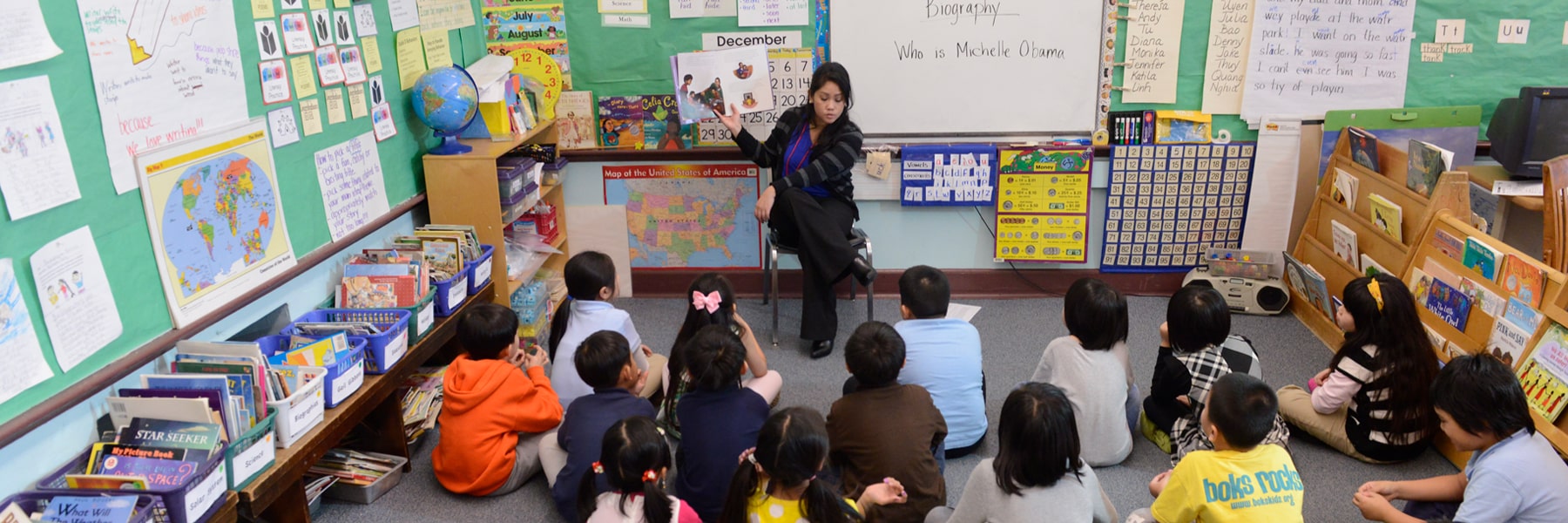
Early Education Graduate Class in session - teacher with students

Learn from leaders in innovative teaching.

Our faculty are globally recognized educational researchers, including Dr. Christopher Martell's research on the teaching of race/racism and social justice within social studies classrooms, Dr. Marcelle Mentor’s work on anti-racist pedagogy in the English classroom, Dr. Janna Kellinger's work on game-based teaching, and Dr. Arthur Eisenkraft's work on teaching active physics.

Program Faculty